
Introducing Kueon: Why I Built It

The idea of Kueon stuck in my mind when a repetitive task started taking some of my productive time. I have been working with a few SaaS products with small teams and limited budgets. Being resourceful, we did not want to spend all our limited money on paid marketing.
We sometimes spent money on things like hiring a content creator to create video content or write a blog now and then, or sponsoring open-source projects here and there, but we did those after our products started making a decent amount of money. Initially, before our products started making money, our major source of user acquisition was almost always jumping into the right conversations on Reddit, X, LinkedIn, or other communities with helpful insights, suggestions, or however we could add value to the conversations and the community.
I have worked as a software developer, handled customer support, published documentation and blogs, and browsed through different Reddit, X, and LinkedIn conversations to see if we could jump in and provide some insights, promote our product somehow, or provide any relevant suggestions. I used to watch competitors’ changelogs, pricing pages, feature lists, and their social handles. And I loved every part of developing a complete system, from development to marketing.
In those, I specifically looked for any negative feedback competitors were receiving, any problems users were facing, or any missing features that we had on our roadmap. This was never to monitor competitors and do what they were doing, but to know the direction they were heading towards, to understand how we could do things better than them, and how we could solve the real pain customers were complaining about.
I talked to existing customers almost every day. But we always need to find more ways to acquire new customers. We need to find new ways to let people know about our existence. And we need to let them know about the problem we are solving.
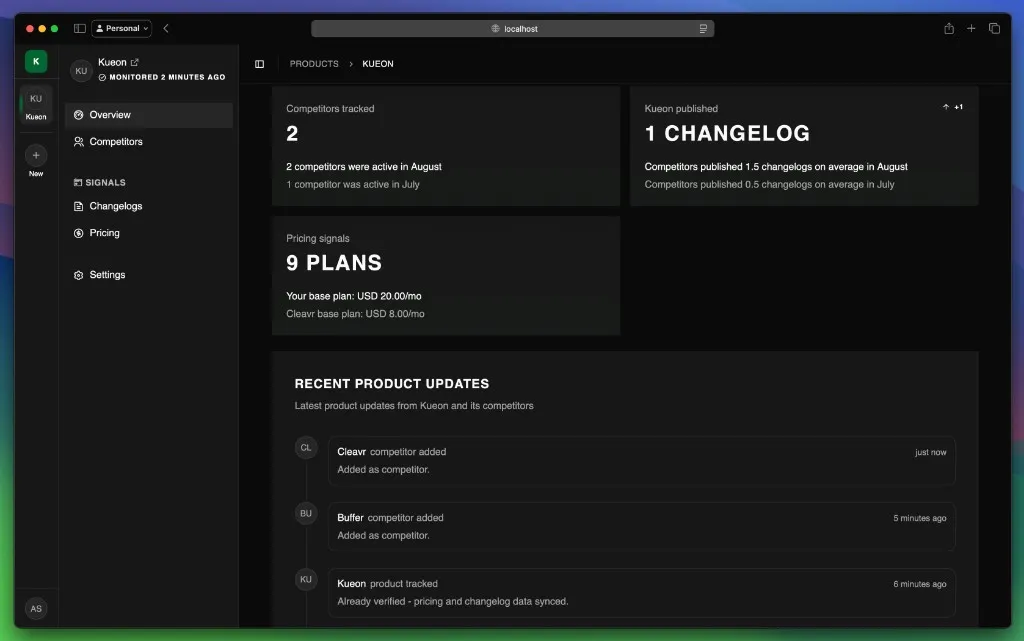
And that’s how the idea of Kueon came to my mind, to solve my own problem. The word Kueon has been derived from the word cue, which means a signal to act. Similarly, Kueon provides signals when competitors make product updates or pricing changes, or when your keywords get mentioned in conversations. You can take these signals and either stay informed or take action.
You don’t need to act on every signal, like pricing changes, but you can stay informed without switching between multiple tabs, searching their social profiles, or browsing their pricing and changelog pages.
But if there are a lot of conversations around people searching for alternatives to your competitors, you can maybe jump into the discussion, provide some insights, and let them know your product exists and that you solve those problems. Or maybe publish blogs, videos, or posts more frequently about how your product exists and solves the same set of problems.
Kueon currently allows you to add competitors, set up their pricing and changelog URLs, manage keywords, and get notified when your competitors publish new changes, make pricing updates, or when the keywords you are managing get mentioned in Hacker News or Reddit discussions.
The product and competitor setup processes are kind of boring tasks, and we have been able to make the onboarding process smarter. With the help of sitemaps, index page content, and generative AI, we have been able to automatically suggest product profile information, competitor information, and platform-specific keywords.
If the problem I faced matches yours, please give Kueon a try. We are still in our early days, and we very much welcome any feedback or suggestions. You can write to us at hello@kueon.com.